The dictionary generally defines ‘reasoning’ as the action
of thinking about something in a logical, sensible way. However, from an academic
point of view, reasoning is defined as a crucial element in achieving this aim
is to facilitate the development of numerical reasoning: the ability of the
learner to apply their numeracy to a multitude of contexts in order to solve
problems.
There are reasons why teaching and learning focuses on reasoning
in the classroom, logical reasoning requires meta-cognition (thinking about
thinking). It influences behaviour and attitudes through larger engagement,
requesting appropriate help (self-regulation) and seeking conceptual
understanding. Reasoning promotes these traits because it requires children to
use their mathematical vocabulary. In short, reasoning requires a lot of active
talk. Active listening is equally important and if done right can also ensure
increased learning autonomy for pupils.
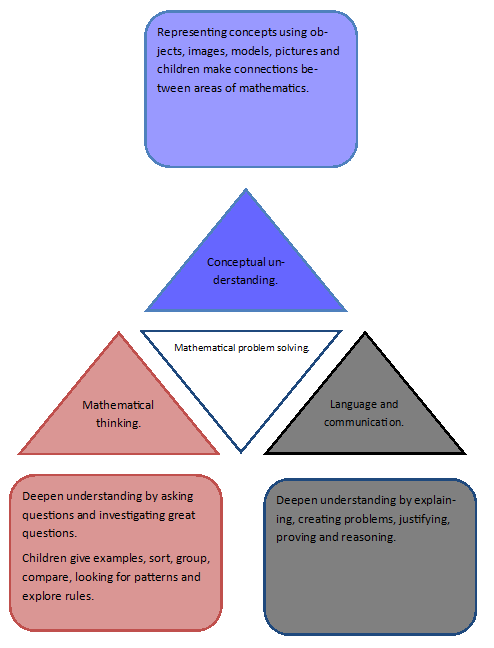
Helen Drury cleverly details what should underpin mathematics teaching and learning. It can be used as a good starting point to redesign the mathematical curriculum with a focus on reasoning and problem solving. 5 principles were created from this chart for developing reasoning in the primary classroom;
1 - start lessons with a question
2 - students needs to wonder and struggle
3 - the teacher is not the answer key
4 - say yes to the students original ideas (but not yes to the methodical ideas)
5 - play!
When children learn problem-solving skills they gain confidence in their ability to make good decisions for themselves. Using effective problem solving techniques will help children avoid conflicts in a school setting and in their day to day lives. It can also strengthen children beginning empathy skills. It can help children learn more positive attributions about other persons' intentions. Problem solving is essential for school readiness and academic success. There are a few steps to follow when using problem solving skills in an academic perspective;
- Define the problem - looking at the situation or the problem carefully: try to be specific while defining the problem, do not try to look at the situation before thinking about it.
- Identify options - making a list of all that you can do: try to be creative and think of all possible options, try to avoid the more obvious options.
- Identify the best solution - thinking about each option and selecting the best one: try to be sure that the selected solution will produce the desired results, try to avoid selecting the easiest option.
- Plan to achieve the best solutions - thinking about how to get at the solution and enlisting the resources needed to achieve the solution: try to think through the plan and how the solution thought of will affect other people, try not to reject other ideas.
- Evaluate results - to determine if it is the best possible solution to the problem: evaluation should be immediate and not be to delayed, try to avoid the assumption that the problem will stay solved.
So, what is problem solving and why is it important?
The ability to solve problems is a basic life skill and is
essential to our day-to-day lives, at home, at school and at work. We solve
problems everyday without really thinking about how we solve them. An example
would be; its raining and you need to go to the store. What do you do? There is
a numerous amount of solutions. Take an umbrella and walk. If you don’t want to
get wet, you can drive, or take the bus. You might decide to call a friend for
a lift, or you might decide to go to the store another day to avoid the rain
all together. There is no right way to solve this problem and different people
will solve it differently.
Problem solving is the process of identifying a problem. Developing
possible solution paths and taking the appropriate course of action.
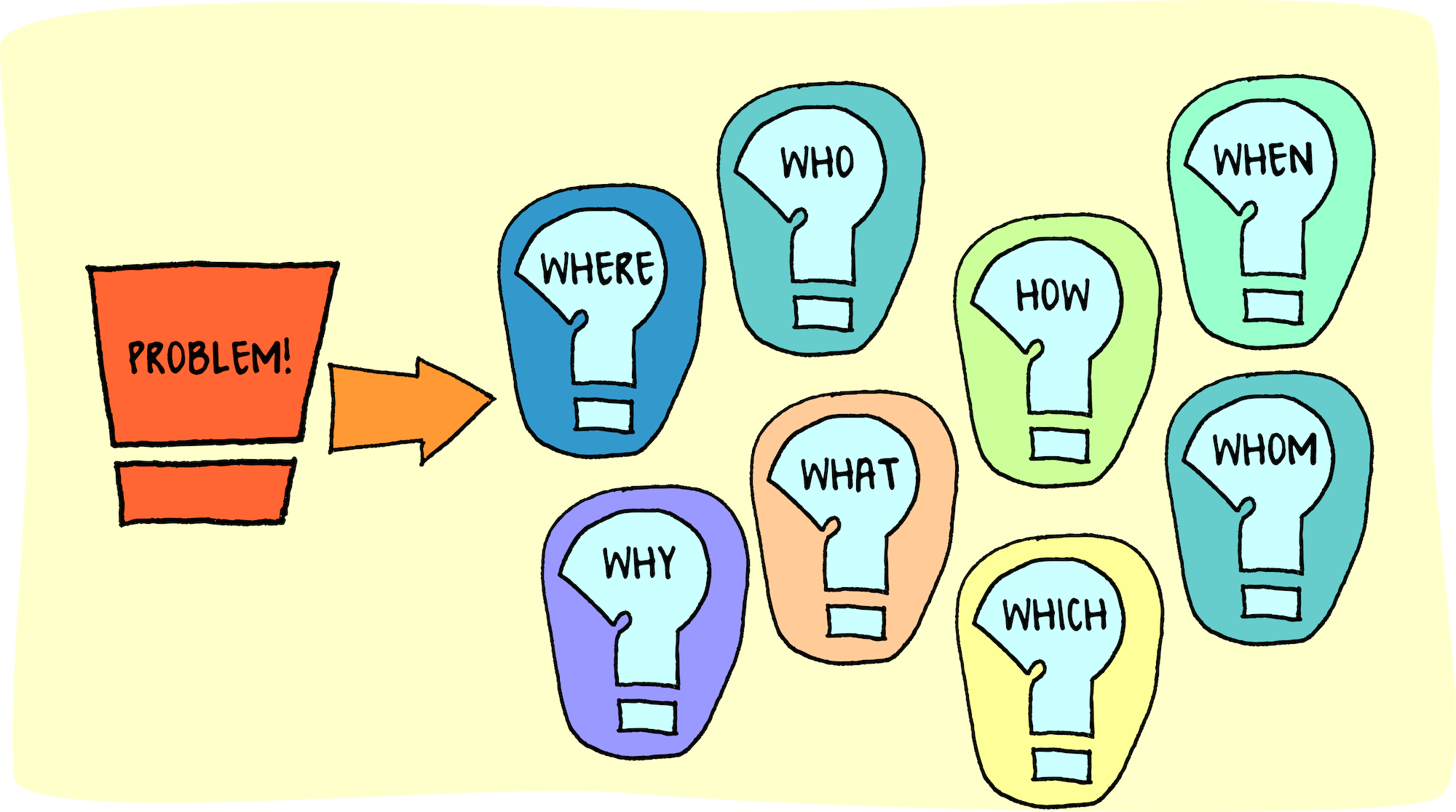
Problem solving is the process of identifying a problem. Developing
possible solution paths and taking the appropriate course of action.
Tim Hicks, 2018 has wrote about the 7 stages of problem
solving in education and how problem-solving effects education. The stages are
clear and constructive.
1
Identify the issues;
·
Be clear about what the problem is
·
Remember that different people might have
different views of what the issues are
·
Separate the listing of issues the identification
of interests
2
Understand everyone’s interests;
·
Critical step usually missed
·
Interests are the needs that you wan satisfied by
any given solution. Often ignore the true interests as we become attached to
one solution
·
The best solution is the one that satisfies everyone’s
interests
·
Time for active listening
·
Separate the naming of interests from the
listing of solutions
3
List the possible solutions (options);
·
Time for brainstorming, lots of room for
creativity
4
Evaluate the options;
·
What are the pluses and minuses?
5
Select an option or options;
·
What is the best option in the balance?
·
Is there a way to bundle several options
together for a more satisfactory solution?
6
Document the agreement(s);
·
Don’t rely on memory
·
Writing it down will help you think through all
the details and implications
7
Agree on contingencies, monitoring and evaluation;
·
Conditions may change. Make contingency
agreements about foreseeable future circumstances
·
How will you monitor compliance and
follow-through?
·
Create opportunities to evaluate the agreements
and their implementation
This process can be used in a large group, between two
people, or by one person who is faced with a difficult decision. The more
difficult and important the problem, the more helpful and necessary it is to
use a disciplined process.
Effective problem solving does take some time and attention
more of the latter than the former. But less time and attention than is
required by a problem not well solved. What is really takes is willingness to
slow down. A problem is like a curve in the road. Take it right and you’ll find
yourself in good shape for the straight away that follows. Take it too fast and
you might not be in as good shape. (Tim Hicks, 2018)
References
Reasoning in the classroom https://hwb.gov.wales/respository/resources/1f8bd393-a5e6-479b-8ba0-0a1ccc1b1222/en
dated: 2019 (accessed on 17.06.19)
Third Space Learning https://thirdspacelearning.com/blog/developing-reasoning-skills-maths-ks2/#
dated: 2019 (accessed on 17.06.19)
Role of teacher in teaching problem-solving skills
https://www.academa.edu/6891418/Role_Of_Teacher_In_Teaching_Problem-Solving_Skills
(undated) (accessed on 17.06.19)
What is problem solving and why is it important? https://ccmit.mit.edu/problem-solving/ (undated) (accessed on 08.07.19)
Seven Steps to Problem Solving in the Workplace https://www.mediate.com/articles/thicks.cfm (Tom Hicks, 2018) (accessed on 08.07.19)
What is problem solving and why is it important? https://ccmit.mit.edu/problem-solving/ (undated) (accessed on 08.07.19)
Seven Steps to Problem Solving in the Workplace https://www.mediate.com/articles/thicks.cfm (Tom Hicks, 2018) (accessed on 08.07.19)

No comments:
Post a Comment